
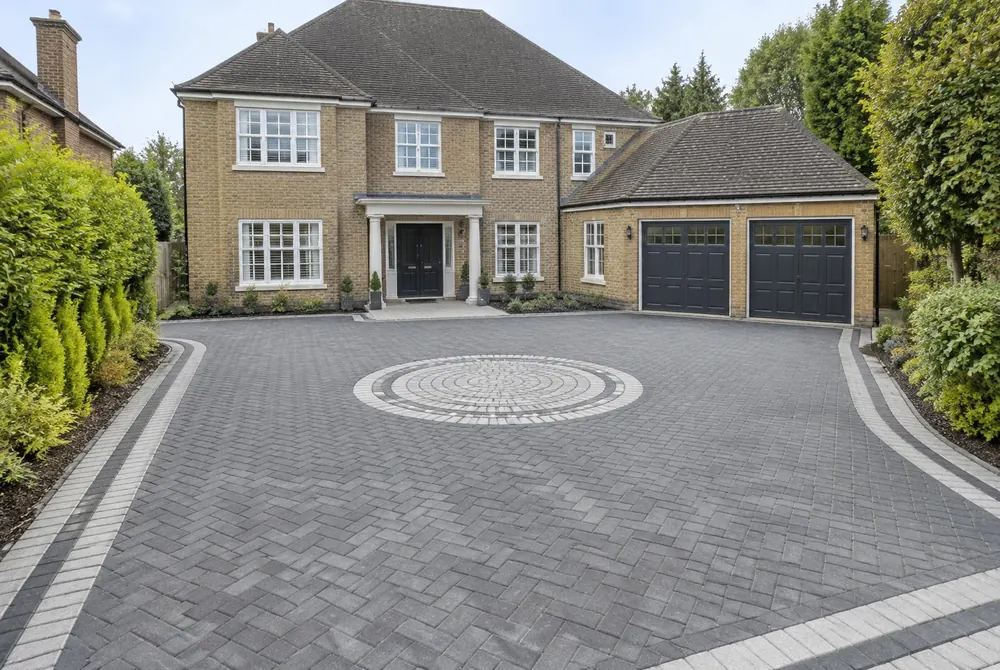
Block paving is hard-wearing, but two complaints come up again and again: weeds pushing through the joints, and blocks that dip, rock or form ruts where cars park. Both are usually symptoms of something underneath or between the blocks, rather than a problem with the blocks themselves.
This guide explains the common causes, what you can deal with yourself, and when the only lasting answer is to lift and relay. It is written for owners of larger drives where patching keeps coming back.
Why weeds grow in block paving joints
Weeds rarely grow up from the soil beneath a well-built drive. Most start from seeds that land in the joints, where wind-blown dust, leaf litter and silt build up into a thin layer of growing medium. Moss and algae follow in shady or damp areas. The more the jointing sand has washed out, the deeper that pocket of debris becomes.
Jointing sand is lost through rain, heavy jet washing, sweeping and road sweepers on the edge. Once the joints are partly empty, blocks can also move against each other, which is why weedy joints and loose blocks often appear together.
Will jet washing fix it?
A pressure washer removes surface growth quickly, but it also strips the sand from the joints. Unless the joints are refilled with kiln-dried sand straight afterwards, the next crop of weeds has more room than before. Many owners find a drive looks better for a month and worse after a year.
A gentler routine works better: sweep regularly, remove weeds by hand or with a suitable treatment, then brush fresh jointing sand into any open joints. Polymeric or resin jointing compounds can reduce weed growth, but they need clean, dry joints to bond and are not a cure for a failing base.
Why block paving sinks
Sinking almost always comes from below. Common causes include a sub-base that was too thin or poorly compacted, clay softening when it gets wet, a trench for drains or cables that was never compacted properly, tree roots, or a laying course of sand that has washed away through gaps at an edge or a gully.
The pattern helps with diagnosis. Twin ruts where cars park point to an undersized sub-base. A neat line of hollows often follows a services trench. A dip next to a gully or drainage channel suggests water escaping and carrying sand with it. Our driveway sub-base depth guide explains the layers a vehicle drive normally needs.
- Ruts in wheel lines: thin or weak sub-base
- Straight-line dips: old trenches settling
- Hollows by drains: sand washing out
- Bulges near trees: roots lifting the base
Loose, rocking and spreading blocks
Blocks that rattle underfoot or creep outward usually mean the edge restraint has failed. Edging kerbs hold the whole surface in compression. If they were laid without a proper concrete haunch, or have been knocked by vehicles, the field of blocks starts to spread and joints open up.
Rocking can also follow from a laying course that is too deep or uneven. In each case the fix involves restoring the edge and the bedding, not adding more sand to the top.
Can sunken areas be lifted and relaid?
Yes, and this is one of block paving's strengths. Blocks can be lifted, cleaned and stored, the cause underneath repaired, and the same blocks relaid so the patch blends in. The key is fixing the reason it sank. Relaying on the same weak base usually brings the same dip back.
Where large areas have failed, or the drive was built without a proper sub-base, a full rebuild may be more sensible than repeated repairs. That is the kind of decision we make on site after looking at the levels and lifting a test area.
Preventing the problem on a new drive
Most sinking is avoided at the build stage: digging out soft ground, using enough well-compacted Type 1, laying a consistent bed, fitting haunched edges and planning where water goes. Spending more on preparation is usually cheaper than relaying in a few years.
Need it sorted? Book block paving
Services this relates to
Want the figure for your own property? Call 07770 880587 or email enquiries@breakinggroundltd.co.uk and we will arrange a site visit.