
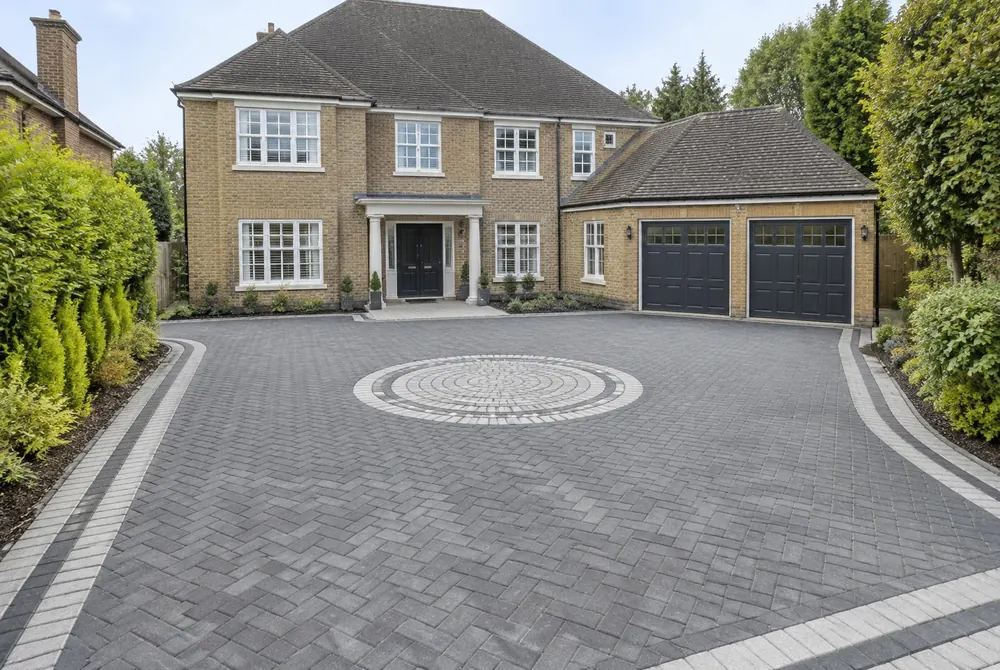
Driveway edging restrains the surface and base while defining levels and water routes. Choose the border for the surface, vehicle loading and layout, then specify its bedding and restraint. A decorative strip alone is not a complete edge detail.
At a glance
- Match the restraint to resin or block paving construction.
- Include curves, entrance details and drainage interfaces.
- Investigate the supporting base if existing borders move.
Edging is easy to treat as decoration, a contrasting line chosen at the end. On a driveway it is much more than that. The edge holds the surface in place, stops the base spreading under load and defines where water goes.
When drives fail, the edges are often the first place it shows: blocks drifting outwards, resin crumbling at the margins, kerbs tilting into flower beds. Getting the edge right is one of the cheapest ways to protect the whole surface.
What edging actually does
- Restrains block paving so the field of blocks stays tight
- Gives resin a clean, solid line to finish against
- Stops the sub-base and bedding layer spreading sideways
- Separates the drive from lawns, beds and gravel
- Helps direct surface water towards drains or planting
Edging options: kerbs, block or sett borders, steel
Concrete kerbs and edging units are robust and suit wide frontages. A border of blocks or setts, often in a contrasting colour, frames the drive neatly and can tie in with the house. Natural stone setts give a traditional look. Steel or aluminium edging creates a slim, almost invisible line that suits contemporary resin drives and curved layouts.
Edging for resin bound drives
Resin needs a firm, straight edge to trowel against, and it must be laid within a fully restrained perimeter. Block or sett borders are popular, steel edging gives a minimal finish, and existing walls can act as an edge where sound. The edge height is set so the resin finishes flush and water drains as designed. Our resin driveways page covers the full build up.
Edging for block paving
With block paving, the edge course is what keeps the interlocking pattern working. Without a rigid restraint, blocks creep outwards under traffic, joints open and sand washes out. Edge courses are bedded on concrete rather than sand and laid before the main field so the infill can be compacted against them.
Haunching and the concrete you never see
Haunching is the wedge of concrete placed against the back of an edge unit, sloping down to the base. It locks the edging in place and resists the sideways force of vehicles turning. Too little concrete, or concrete laid too low, is a common shortcut that saves an hour on day one and costs a relay a few years later.
Signs of failing edging
Look for gaps opening between the border and the main surface, blocks sitting proud or sunken along the edge, cracked or loose kerbs, and weeds growing along the margins. Often the root cause sits below the edging in a thin or poorly compacted base, explained in our driveway sub-base depth guide. Edging is designed as part of every driveway we build.
Price the border by its detail, not appearance alone
Ask how curves, cuts, retained walls and drainage channels meet the new edge. Perimeter length and those junctions can change labour even when the paved area is unchanged. Compare the complete driveway cost scope with the driveways service, then send your layout to discuss a coordinated frontage.
Services this relates to
Want the figure for your own property? Call 07770 880587 or email enquiries@breakinggroundltd.co.uk and we will arrange a site visit.