
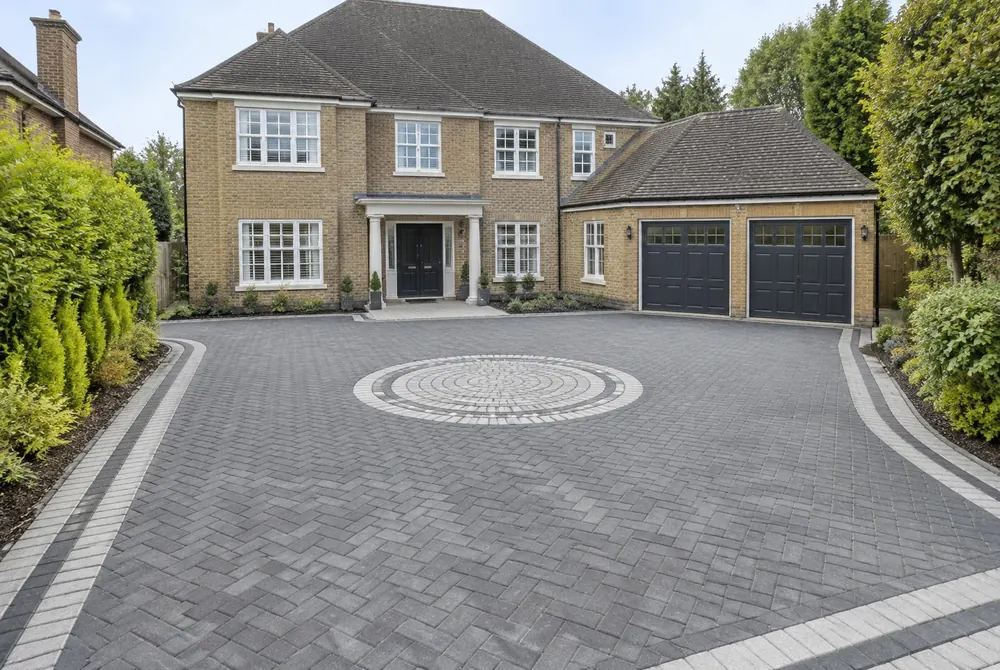
Block Paving
Block paving for substantial driveways and detailed borders
Traditional and contemporary block paved driveways on a properly built sub base, with edging that stays put.
The approach
A driveway is a structure, not a covering.
Block paving fails for predictable reasons: not enough excavation, a thin sub base, edge courses laid without haunching, and joints never topped up. Fix those four things and a block driveway will still look sharp in twenty years, which is why we build them the way we do.
We dig to the depth the ground and the traffic require, build and compact the sub base in layers, haunch every edge restraint in concrete, lay to a set pattern with consistent joints, then compact and joint with kiln dried sand.
The border matters as much as the field; read about driveway edging options before choosing.
Choose the block layout before comparing contractors
Block paving is a modular surface, so the pattern and module should be considered together. Turning traffic, cut positions at thresholds and the line of the border affect the result. A cobble-style driveway appearance can be considered through block shape and texture; a rounded-looking unit does not remove the need for adequate restraint and supporting construction.
The driveways hub deals with parking geometry and the whole frontage. This sub-service concerns the block installation itself. Our block paving cost guide separates materials from preparation, while the resin and block comparison explores which finish suits different layouts. Use them to compare specification rather than choosing a contractor from a surface-only total.
Local frontage requirements differ: Colchester driveways emphasise drainage and the highway interface, Chelmsford driveways consider parking and entrances, and Ipswich driveways address gradients and formation. Those pages apply the design questions to their own settings without changing the underlying need for correctly installed blocks.
For a border that needs to retain the field as well as frame it, consult the driveway edging guide. Width, cutting detail and transitions should be visible on the plan before ordering units. Thinking through these edges early helps avoid narrow infill pieces or a decorative band that cannot resist the movement of the drive.
What affects the cost
Block paving costs depend on excavation depth, ground conditions, access, drainage, edging, pattern and material choice. We price every job from a site visit with a fixed, itemised quote. Guide figures only, because levels, access and drainage decide the final price. Every quotation we issue is fixed and itemised.
Excavation and sub base
Dug out to suit the subsoil and vehicle loading, geotextile membrane where needed, sub base built and compacted in layers.
Edge restraint
Kerbs and edge courses fully haunched in concrete so the driveway cannot spread at the margins over time.
Laying and detail
Herringbone, stretcher and circle features, contrasting borders, cut lines kept tight and falls set away from the house.
Drainage compliance
Permeable build ups, linear drainage and soakaways so surface water is dealt with on site and within regulations.
Who this suits
Large frontages, in and out drives, courtyards and turning circles where the finish and the setting out actually matter.
- Deep excavation
- Haunched edgings
- Kiln dried jointing
Read before you commit
- Block paving cost per square metre, explained properly
Compare block selection, cutting and the supporting layers as separate costs.
- Resin or block paving? An installer's honest comparison
Weigh modular paving against a continuous aggregate appearance.
- Do you need planning permission for a driveway?
Check whether the proposed parking surface needs an application.
- Getting a dropped kerb in Essex: rules and requirements
Review the crossing independently from the paving inside your boundary.
- Driveway drainage done properly: permeable bases, soakaways and SuDS
Trace runoff through the paving system to a suitable destination.
- How deep should a driveway sub-base be?
Consider how traffic and subsoil affect the layers below the units.
- Driveway edging: options, haunching and why it matters
Choose a perimeter detail that contains the field and complements its pattern.
- Block paving weeds and sinking: what causes them
Why blocks sink and joints sprout weeds, and when to relay.
- Groundworks in Essex: what homeowners should know before starting
How ground, councils, highways and flood risk shape driveways, extensions and new builds across Essex, with links to our detailed guides.
- How many years should you expect from a driveway?
A driveway's useful life depends on the structure underneath, the vehicles using it and whether developing faults receive the right attention.
- What happens each day when a new driveway is installed?
Follow the work from the first level marks to the moment you can park on your finished driveway.
- Can driveways and foundations be laid safely in winter?
Winter construction depends on ground condition, product limits and overnight protection, not simply whether the working day feels mild.
- How should you lay out a driveway on a big frontage?
Give a generous frontage clear routes, comfortable parking and a welcoming entrance without turning every available metre into driveway.
- What does widening an existing driveway cost?
A driveway extension budget needs to cover a complete new construction beside the old surface, not just extra paving.
- Choosing an installer for a resin or block paved driveway
A successful driveway appointment starts with the construction beneath the surface and the way rainwater will leave the finished area.
- Tarmac driveway cost: what belongs in the comparison
An overlay price and a rebuilt frontage price describe different projects. Establish which construction you are comparing before choosing a finish.
Covering 30 miles of Colchester, including Colchester, Chelmsford, Ipswich, Braintree, Witham, Maldon, Sudbury, Clacton-on-Sea and Halstead.
Request a consultation
We take on new build contracts and substantial driveway and garden projects. Give us the detail and Matt will come back to you personally.
Questions we are asked
Block Paving: your questions
How much does block paving cost per square metre?+
Excavation depth, ground conditions, access, drainage, edging, laying pattern and block choice all affect cost. We price every driveway from a site visit with a fixed, itemised quote.
Do I need planning permission for a block paved driveway?+
Not where the surface is permeable or drains within your own boundary. Permission is needed only if more than five square metres of impermeable surfacing sheds water onto the road, or your property has restricted rights.
How long will a block driveway last?+
Twenty years or more where excavation, sub base and edge haunching are right, with jointing sand topped up occasionally. Rutting and edge spread almost always trace back to preparation.
Can a sunken block driveway be repaired rather than replaced?+
If the original sub base was adequate, a localised lift and relay is often the right answer and much cheaper. Where the base was never right, relaying the same blocks onto the same ground buys about two years.
Will you match blocks to my existing paving?+
Often close, though weathering makes an exact match unlikely. Where a match would look like a repair, we usually suggest a deliberate change of border or banding instead.
Breaking Ground. Building Trust.
Discuss block paving for your property
Bring your frontage layout and the block patterns or border details you are considering.
Ten year guarantee on extensions and new builds / 30 miles of Colchester / Substantial projects