
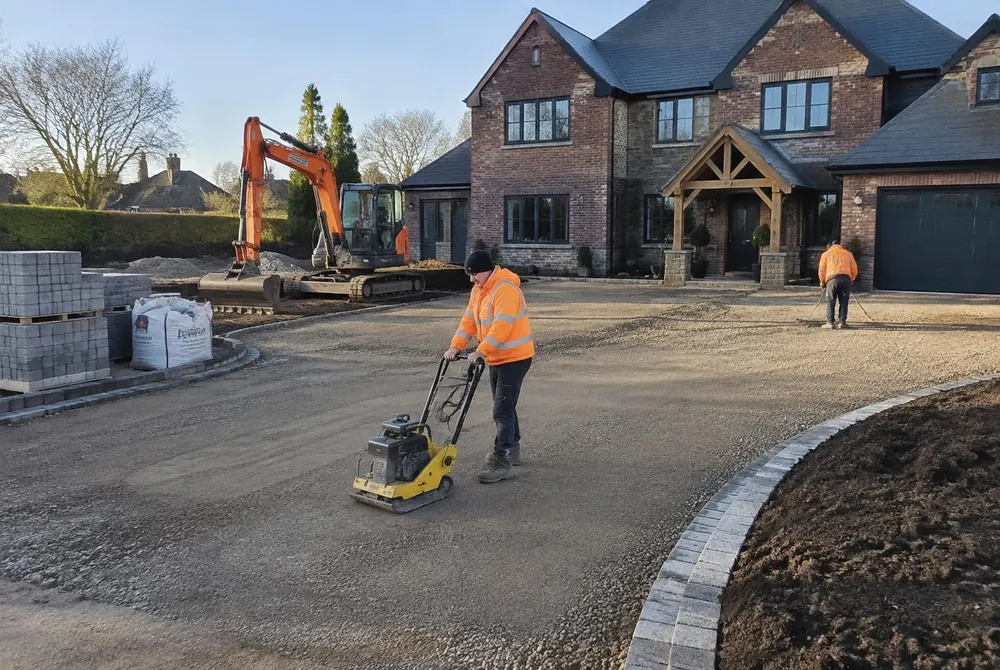
Essex is a large county with very different ground, rules and property types from one district to the next. A driveway in a Colchester suburb, an extension in a Braintree district village and a new build near the Chelmer each raise their own questions before a spade goes in.
This guide pulls together what Essex homeowners usually need to check, and points to the pages on this site that go into each subject in detail. We work within about 30 miles of Colchester, which covers much of north and mid Essex and parts of south Suffolk.
Who decides what in Essex
Essex has two tiers of local government in most areas. Your district, borough or city council handles planning and building control questions, for example Colchester City Council, Chelmsford City Council, Braintree District Council, Tendring District Council or Maldon District Council. Essex County Council is the highway authority for most roads, so anything touching the pavement or verge, such as a new vehicle crossing, goes through the county rather than the district.
Southend-on-Sea is a unitary authority, so planning and highways are handled by the one council there. Checking which body you need first saves weeks of emails sent to the wrong office.
Ground conditions vary across the county
Much of Essex sits on clay that shrinks in dry summers and swells in wet winters, which affects foundation depth, especially near trees. Other areas, including parts of Colchester and Chelmsford, sit on river terrace gravels that drain far more freely. Neither should be assumed for a particular garden: a trial hole or soil investigation tells you what is actually there.
For extensions and new builds, building control and the engineer will set foundation depths once the ground is known. For driveways, the ground decides how deep the sub-base must go and whether a soakaway will work. Our guide to building on clay soil explains the foundation side in more detail.
Water, flooding and drainage
Rivers such as the Colne, Chelmer, Can, Blackwater and Stour run through the county, and land along them falls within Environment Agency flood zones. If your property is in or near one, an extension may need a flood risk assessment, and a new driveway should be designed so rainwater soaks away or drains to a suitable point rather than onto the road.
Since 2008, a new or replacement front garden surface of more than five square metres generally needs planning permission unless it is permeable or drains to a lawn or border. Resin bound surfaces and permeable block paving are common ways to meet this. Our guides on driveway drainage and planning permission cover the rules.
Highways and dropped kerbs
Widening a drive or adding a new one often means crossing the footway. In most of Essex this needs approval from Essex County Council, and the work in the highway must be carried out under the street works rules that apply to anyone digging in a public road. Visibility, trees, lamp posts and the classification of the road all play a part. Our dropped kerb guide explains the process step by step.
Conservation areas and older homes
Essex has many conservation areas and listed buildings, from historic town centres to village greens. Within them, front boundaries, walls and hard surfaces can need consent that would not apply elsewhere, and materials are expected to suit the setting. If your home is listed or in a conservation area, ask the council early, before choosing a surface or designing an extension.
Matching the contractor to the size of the job
County-wide, homeowners often find that the firm who suits a quick repair is not the one to dig footings for a two-storey addition. Breaking Ground concentrates on the substantial end of the market, so this overview is written for people planning a whole new frontage, a self-build plot, a rear extension or a full garden rebuild.
Before asking anyone to price, gather what you already have: drawings, any soil report, photographs of the access and a note of trees near the work. It shortens the first conversation and makes quotes easier to compare.
Where to go next
If you know your town, our areas pages give local detail for places such as Colchester, Chelmsford, Braintree, Witham, Maldon and Clacton-on-Sea. If you know the job, the service and cost guides linked below explain each stage. Either way, the next useful step is a site visit, where we measure, check levels and access, and then send a written quote.
Need it sorted? Book Request a site visit in Essex
Services this relates to
Want the figure for your own property? Call 07770 880587 or email enquiries@breakinggroundltd.co.uk and we will arrange a site visit.